The Case for a Routing Operating System
There's a mental model most revenue teams carry into their CRM setup that quietly causes problems for years before anyone names it.
The model goes like this: if we configure our CRM correctly — the right fields, the right workflows, the right automations — our revenue operations will run correctly. The CRM is the system. Get it right and everything downstream follows.
It's a reasonable assumption. CRMs are powerful, central, and deeply embedded in how revenue teams operate. But it conflates two things that are actually distinct: a system for storing and organizing customer data, and a system for running the operational logic that sits on top of that data.
These are different systems. Treating them as one is where the problems start.
What a CRM is actually for
A CRM is a data system. Its job is to store your customer relationships accurately, make that data accessible to the people and tools that need it, and provide a record of what happened across every interaction.
CRMs do this extraordinarily well. The best ones — and the category has matured significantly over the last decade — give revenue teams a reliable, integrated picture of their customer base. Contact records, company hierarchies, deal pipelines, activity histories, lifecycle stages. Clean, queryable, connected.
This is genuinely hard to build and genuinely valuable to have. The CRM is the right system for this problem.
But storing what happened is a different problem from determining what should happen. And the logic that answers "what should happen to this lead" — which rep gets it, based on what rules, enforced by what SLA, verified by what audit — is not a data problem. It's an operational infrastructure problem.
CRMs are not designed to be operational infrastructure. They provide the building blocks — ownership fields, automation primitives, conditional logic — but building blocks require assembly. And when the assembly is complex enough, the thing you're building deserves its own system.
The gap no one names
Walk through what actually happens when a lead enters most revenue teams' systems.
A contact submits a form. A workflow fires. The contact enrolls based on some criteria, routes through a branching logic that someone built eighteen months ago, and lands with a rep — if everything works correctly. If it doesn't work correctly, the contact sits unowned, or routes to the wrong rep, or triggers a notification that doesn't reach anyone, or gets correctly assigned to a rep who has no idea it happened.
The people responsible for making this work — RevOps teams — spend significant time maintaining the system that's supposed to run automatically. Updating workflow user lists when reps change. Debugging routing failures when a lead doesn't behave the way the logic expected. Rebuilding territory rules when coverage changes. Investigating rep complaints about distribution imbalances. Answering the question "what happened to this lead?" by manually tracing through activity logs and workflow history.
None of this is the work RevOps teams were hired to do. It's the overhead generated by treating routing as a configuration problem rather than an infrastructure problem.
The gap is the space between what the CRM provides and what a functioning routing system actually requires. Most revenue teams live in this gap, filling it with workflows, spreadsheets, tribal knowledge, and RevOps time.
The gap doesn't have a name, which is part of why it persists. It's not a CRM failure — the CRM is doing exactly what it was designed to do. It's not a RevOps failure — the team is building the best system they can with the tools available. It's a category gap. There's a system that needs to exist that mostly doesn't.
What routing infrastructure actually requires
The argument for a dedicated routing layer starts with being specific about what routing actually needs to do — beyond assignment.
Routing needs to be visible as a whole. Not workflow by workflow, not setting by setting — as a complete system. What happens to a lead from the moment it enters until the moment a rep works it, including every condition, every branch, every fallback. A routing system you can't see is a routing system you can't trust.
Routing needs to be maintainable without expertise. When a rep joins or leaves, when a territory gets restructured, when an SLA policy changes — the routing system needs to update in minutes, not hours. It needs to be maintainable by the RevOps generalist responsible for it, not the engineer who built it.
Routing needs to know about accounts, not just contacts. An incoming contact exists in a relationship context — they may belong to an existing account, an active deal, a named prospect list. Routing that ignores that context makes expensive mistakes. The routing system needs to do the matching work to understand that context before making an assignment decision.
Routing needs to enforce, not just assign. Getting a lead to a rep is the beginning, not the end. What happens after assignment — whether the rep works the lead within the required window, what happens if they don't, how breaches are logged — is part of the routing system's responsibility. Enforcement without visibility is aspiration. Enforcement with audit is infrastructure.
Routing needs to be auditable. When something goes wrong — and in any sufficiently complex routing system, things go wrong — you need to be able to reconstruct exactly what happened. Not approximately, not after thirty minutes of log-tracing, but definitively and quickly. An audit trail is what separates a routing system from a routing approximation.
None of these requirements are exotic. They're the baseline expectations for any operational infrastructure. The fact that most revenue teams don't have a system that meets them isn't a reflection of what's possible — it's a reflection of the fact that the category of tool designed to meet them has been slow to develop.
Why this is a category problem, not a configuration problem
The instinct when routing breaks is to fix the configuration. Add another workflow branch. Build a more sophisticated round-robin. Write a custom code action to handle the edge case. Each fix is rational. Collectively they produce a system that's more complex, harder to audit, and more expensive to maintain than before the fix.
This is the symptom of treating a category problem as a configuration problem. The issue isn't that the routing logic is wrong — it's that routing logic built inside a general-purpose automation layer was never going to scale cleanly. The tool isn't the right tool for the job.
The same pattern played out in adjacent infrastructure categories. Marketing teams tried to run attribution inside their CRM before attribution tools existed as a category. Sales teams tracked commissions in spreadsheets before commission software became a standard part of the stack. In both cases, the eventual answer wasn't a better spreadsheet or a more elaborate CRM configuration — it was a purpose-built system for the specific operational problem.
Routing is at the same inflection point. The revenue teams that are going to build the most reliable, maintainable routing operations aren't going to get there by configuring their CRM more cleverly. They're going to get there by treating routing as its own system.
What a routing operating system actually looks like
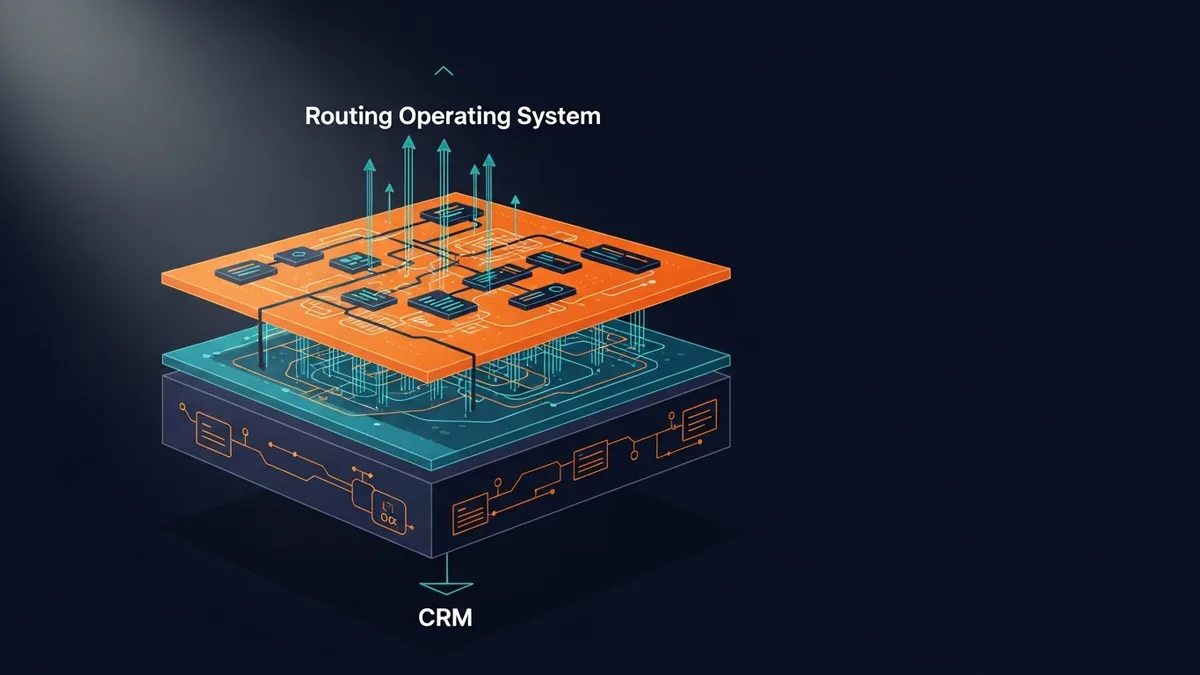
The term matters because it names the right category. An operating system doesn't just store data or execute individual tasks — it manages and coordinates the resources and processes that other systems depend on. A routing operating system is the layer that manages and coordinates how leads move through your revenue system: who gets what, under what rules, enforced by what policy, visible to whom, auditable after the fact.
Concretely, it means:
A visual representation of your routing architecture — not a list of workflows, but a canvas where the full routing flow is legible. Every condition, every branch, every fallback, visible as a connected system.
Territory and account matching as first-class concepts — not approximated in workflow conditions, but managed as defined objects with their own lifecycle. When coverage changes, you update the routing object. The routing logic follows automatically.
SLA enforcement that's operational, not aspirational — timers, escalation paths, and breach logging that function reliably across business hours, time zones, and rep availability states.
A complete audit trail — the ability to look at any lead and reconstruct its full routing journey in seconds, from entry to assignment to first touch.
Analytics that tell you whether the system is working at scale — distribution by rep, by source, by territory, over time — so imbalances surface as data rather than rep complaints.
This is the system that sits above the CRM, reads from its data model, writes clean assignments back into it, and handles the operational logic the CRM was never designed to own.
The teams that build this first win
There's a compounding advantage to getting routing infrastructure right early.
When routing works reliably, RevOps capacity shifts from maintenance to strategy. Instead of debugging workflow failures and investigating lead complaints, the team is building the systems that improve conversion, tighten forecasting, and scale the revenue operation.
When routing works reliably, reps trust the system. They stop monitoring queues manually, stop questioning distribution, and direct their energy toward pipeline. The cultural overhead of routing distrust — the invisible tax it places on rep behavior — disappears.
When routing works reliably, the revenue organization can change faster. New territories can be added without weeks of workflow updates. New reps can be onboarded into routing pools in minutes. Coverage model changes propagate through the system rather than requiring manual reconfiguration.
And when routing works reliably, you can actually measure it. You can answer the question "is routing contributing to our conversion rate?" with data rather than confidence intervals. You can tie routing decisions to revenue outcomes and optimize accordingly.
The gap between revenue teams that have built this and those that haven't is going to widen. The teams still filling the routing gap with workflows and RevOps time are carrying an operational overhead that constrains how fast they can move. The teams that have treated routing as infrastructure have removed that constraint.
The argument in short
CRMs are data systems. They're excellent at what they were designed to do. The routing operating system is a different layer — the operational infrastructure that sits above the CRM, manages the logic of how leads move through the revenue system, and enforces the policies that determine whether that system works at scale.
Most revenue teams don't have this layer. They have an approximation of it — built in workflow logic, maintained by RevOps time, visible only to whoever built it, and fragile when the team or territory model changes.
Building the routing layer explicitly, as infrastructure rather than configuration, is one of the highest-leverage investments a scaling revenue team can make. Not because routing is inherently interesting — it's not — but because everything downstream of routing depends on it working.
Leads are the top of the machine. Routing is the first mechanism inside it. When that mechanism is invisible, approximated, and manually maintained, everything that follows is less reliable than it should be.
Build the routing layer. Make it visible. Treat it like infrastructure.
FlowRouter is the routing operating system for HubSpot teams — a visual routing layer that sits above your CRM and manages the operational logic your revenue operation depends on. Start a free account and connect your HubSpot in minutes.
See what your routing actually looks like
FlowRouter gives you a single visual canvas for your entire lead routing logic. Connect HubSpot in 2 minutes — no code, no spreadsheets.
Read next
How HubSpot Handles Lead Routing — And Where the CRM Layer Ends
An honest look at what HubSpot provides for lead routing, what it's designed to do well, and where routing infrastructure naturally picks up.
RevOpsHow Round Robin Works in HubSpot — And When Your Routing Needs More
How HubSpot's round-robin assignment actually works, how to configure it correctly, and how to know when your team needs a dedicated routing layer.